

You look for Best Cities in Texas Without a Car?Moving to Texas often evokes images of giant highways, massive pickups, and cities built for cars. Yet in 2026, shifting priorities—rising fuel costs, environmental needs, and a desire for walkable, connected lifestyles—are driving change. While many areas remain car-centric, several urban cores and planned communities now offer walkable environments where public transit, cycling, and mixed-use developments make living vehicle-free both possible and appealing.
For those considering a move to Texas in 2026 without a car, selecting a specific neighbourhood is far more critical than choosing the city itself. The “15-minute neighbourhood” concept—where essentials like groceries, healthcare, and transit are within a short walk—is taking root in the urban centres of Austin, Dallas, and Houston. At ilocality, we analyse these trends through the lens of infrastructure reliability and real-world accessibility. Navigating Texas without a car requires a strategic understanding of light rail networks, bus rapid transit (BRT) lanes, and the growing network of protected bike paths. In this professional guide, we break down the top cities and specific districts where you can hang up your keys and embrace a more mobile, urban lifestyle.
Austin: The Leader in Pedestrian-Centric Urbanism
Austin has long led Texas in walkability. In 2026, the city benefits from massive investments in its “Project Connect” transit initiative. Unlike many other Texas cities that are purely radial, Austin’s central core is designed on a grid that supports foot traffic and cycling. The downtown area, along with neighborhoods like West Campus and the new Mueller district, offers enough density to make owning a car a burden, not a benefit. With Metrorail expansion and high-frequency bus lines, residents can easily move from North Austin to the Lady Bird Lake area.
Moreover, Austin’s commitment to “active transportation” is evident in its hundreds of miles of bike lanes and the iconic Ann and Roy Butler Hike-and-Bike Trail. In 2026, the city is also seeing a surge in “Transit-Oriented Developments” (TODs), where luxury apartments and essential retail are built directly atop transit hubs. This eliminates the “last-mile” problem that plagues so many other Southern cities. If you are a remote worker or a creative professional, Austin offers the smoothest transition to a car-free life if you stay within the primary transit corridors.
- Capital Metro Connectivity: The high-frequency “MetroRapid” bus lines provide service every 15 minutes, making spontaneous travel feasible without a schedule.
- The Mueller Model: This award-winning master-planned community is specifically designed so that every resident is within a 10-minute walk of a grocery store and a park.
- Metro Bike Integration: Austin’s bike-share program is fully integrated with public transit passes, enabling easy multimodal commuting.
- Walkable Downtown Core: With a Walk Score consistently in the 90s, the downtown area offers everything from pharmacies to world-class dining within a few blocks.
Dallas: Leveraging the Largest Light Rail Network
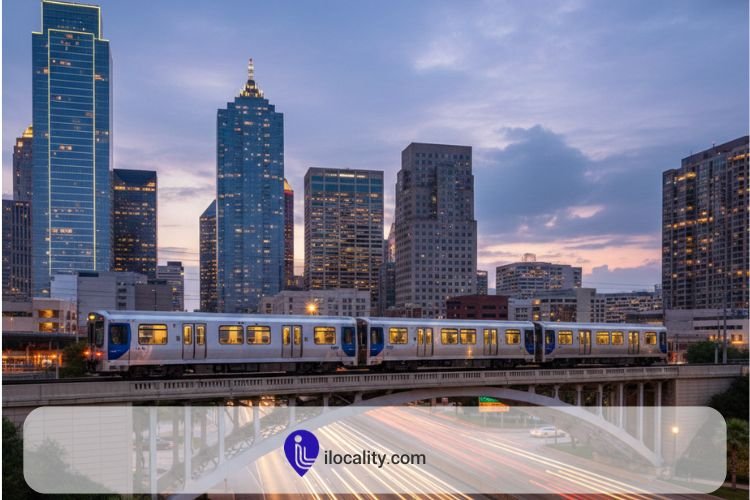
While Dallas is often criticized for its massive freeway system, it actually boasts the longest light rail network in the United States, operated by DART (Dallas Area Rapid Transit). In 2026, this system serves as the backbone for car-free living in North Texas. The DART Rail connects 65 stations across the Metroplex, linking downtown’s Arts District with trendy neighbourhoods like Uptown and Deep Ellum, as well as suburban hubs like Plano and Richardson. For those who need to travel frequently, the rail also provides a direct, inexpensive link to both DFW International Airport and Dallas Love Field, making it a Favorite for business travellers.
The key to car-free living in Dallas is focusing on the M-Line Trolley and the Dallas Streetcar. These provide high-frequency loops through the most walkable districts. Neighbourhoods like Uptown and West Village are self-contained ecosystems where cars are rarely needed. The city has also made progress with the “Green Loop” project—a series of connected parks and trails. These let pedestrians bypass street-level traffic when moving between major districts.
- DART Rail System: Four lines (Red, Blue, Green, and Orange) cover 93 miles of track, providing a reliable alternative to the North Texas Tollway.
- Uptown’s Density: This neighbourhood is the most walkable in the city, featuring a mix of high-rise living, office space, and retail, all accessible via the free M-Line Trolley.
- The Silver Line Expansion: In 2026, the new Silver Line will provide essential east-west connectivity across the northern suburbs, further reducing car dependency.
- Bishop Arts District Access: The Dallas Streetcar connects the central city to this historic district, known for its independent shops and vibrant street life.
Houston: The Rise of the Metrorail and Walkable Hubs
Houston is a city of “islands,” and for the car-free resident in 2026, the key is choosing the right island. The Houston METRORail has transformed the central corridor—running from Downtown through Midtown and the Museum District to the Texas Medical Centre—into a world-class walkable environment. The Texas Medical Centre, the largest medical complex in the world, is a prime example of a “city within a city” where thousands of residents live and work without ever touching a steering wheel. The light rail system is complemented by an extensive “Park & Ride” bus network that is surprisingly efficient for a city of Houston’s scale.
Beyond the rail, Houston’s Tunnel System offers a unique pedestrian experience. It allows residents to navigate the downtown core in climate-controlled comfort—a vital feature during Texas summers. Neighbourhoods like Montrose and the Heights have also become more walkable. “Liveable Centres” studies led to wider sidewalks, better lighting, and the conversion of old industrial sites into mixed-use hubs. Houston is vast, but its core is being designed more for people than for cars.
- Main Line Metrorail: This line is a high-capacity artery connecting the city’s major employment and cultural hubs every 6 to 12 minutes.
- The Tunnel System: Nearly 6 miles of underground walkways connect 95 city blocks, housing food courts, shops, and services.
- BCycle Network: Houston’s robust bike-sharing program features over 100 stations, particularly concentrated in the walkable central neighbourhoods.
- Midtown Connectivity: Located between Downtown and the Medical Centre, Midtown offers the perfect balance of transit access and residential amenities.
Conclusion
Living in Texas without a car in 2026 is no longer a fringe lifestyle choice; it is a practical reality for thousands of residents who prioritize efficiency and urban connectivity. While the state as a whole remains vast, concentrated investments in Austin’s Project Connect, Dallas’s DART expansion, and Houston’s Metrorail have created pockets of high walkability that rival those of major East Coast cities. By focusing your search on neighbourhoods with high Walk Scores and proximity to fixed-rail transit, you can enjoy the economic benefits of the Lone Star State without the financial and logistical burden of vehicle ownership. Success in a car-free Texas move comes down to “Location Intelligence”—and choosing a city that matches your specific mobility needs.
Would you like me to move on to the next topic or provide a specific neighbourhood breakdown for one of these cities?