Austin Grid Failures: How to Keep Your AC Running When the Power Goes Out
Iinjast··5 min read
Reliable cooling is a practical necessity in Austin, but keeping an AC system running during a blackout depends on more than buying a generator with a big number on the label. Many Central Texas homes use 4-ton or 5-ton HVAC systems, and the electrical demand at startup can be far higher than the power needed once the unit is already running. Large west-facing windows, two-story layouts, attic heat, and aging insulation can make that backup-power requirement even harder to manage during a summer outage.
Why Your AC Is One of the Hardest Loads to Back Up
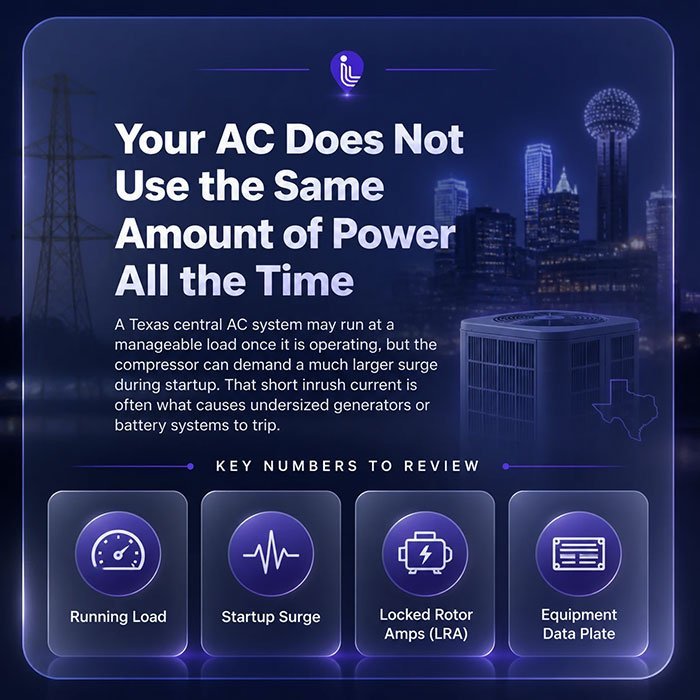
A central AC system is difficult to support during an outage because its electrical demand is not steady. The compressor may settle into a predictable running load after startup, but the initial surge can be several times higher and may exceed what a generator or battery inverter can deliver cleanly. In Austin homes with larger 4-ton or 5-ton units, that short startup event is often the point where an undersized backup system fails, even if the same system appears capable of covering the AC’s normal operating wattage. This is also where Texas heat changes the risk profile. During a summer outage, the AC is usually trying to restart under high outdoor temperature, elevated attic heat, and a home that is already gaining heat through the roof, walls, and windows. That means the system may face a harder restart while the backup source is also carrying other essential loads like the refrigerator, networking equipment, garage controls, or medical devices. A professional load review should look at the AC as part of the home’s full outage profile, not as a single isolated appliance.
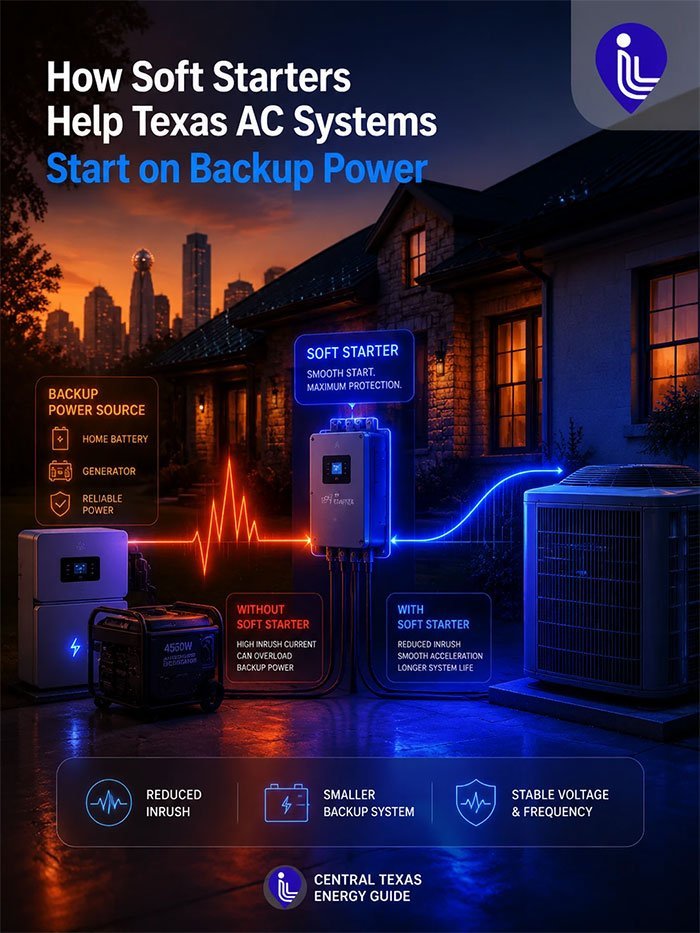
How Soft Starters Help Texas AC Systems Start on Backup Power
A soft starter can reduce the compressor’s inrush current by controlling how aggressively the motor comes up to speed, which may allow an Austin home to start a central AC system on a smaller backup-power setup than would otherwise be required. In practical terms, reducing startup demand can be the difference between oversizing a standby generator for one brief surge event and designing a more balanced system around realistic cooling, refrigeration, lighting, and communications loads. The limitation is compatibility: not every compressor, inverter-driven unit, or modern control board should be treated the same way. Before adding a soft starter, a qualified HVAC technician should verify the equipment data plate, compressor type, warranty considerations, and whether the backup source can still maintain stable voltage and frequency during startup.
Austin Grid Failures
How Soft Starters Reduce AC Startup Stress in Texas Homes
A soft starter is often worth evaluating when an Austin homeowner wants central AC on backup power without sizing the entire system around one short compressor surge. On many conventional 4-ton or 5-ton Texas AC systems, the Locked Rotor Amps can sit well above normal running amperage, sometimes reaching the 100-amp range or higher depending on the equipment data plate. A properly matched soft starter may reduce that inrush demand significantly, which can make the difference between a backup system that trips at startup and one that brings the compressor online cleanly.
The risk is assuming a soft starter is a universal fix. It is not. A technician needs to verify the compressor type, motor design, control board, warranty status, and whether the system is a conventional single-stage unit, scroll compressor, or inverter-driven AC. Scroll compressors and newer inverter systems require particular care because they depend on stable electrical conditions and manufacturer-specific controls. Adding the wrong device, or pairing it with an undersized generator, can create voltage sag during startup. That brownout condition can damage capacitors, stress compressor components, disrupt control boards, and turn a backup-power upgrade into an expensive HVAC repair.
Generator Sizing for Texas AC Loads Is Not a Nameplate Guess
Choosing a generator for an Austin home should start with the AC data plate, not the square footage of the house or a salesperson’s default package. The professional calculation needs to compare starting demand, running load, compressor type, other critical circuits, and the generator’s ability to hold voltage under motor load. A unit that looks large enough in total watts can still perform poorly if it cannot handle the compressor’s startup behaviour while the refrigerator, lights, network equipment, and other essential loads are already online. For many Texas homes, the right answer is not simply “buy the biggest generator”; it is to have an HVAC or electrical professional map the actual outage loads before equipment is purchased.
Whole-Home Backup vs. Critical-Load Backup in Austin Homes
Whole-home backup sounds clean on paper, but it is not always the most efficient way to keep cooling available during a Texas outage. In many Austin homes, a more reliable strategy is to separate the loads that truly matter from the loads that should stay off the emergency system. A critical-load plan may prioritize one AC system or one cooling zone, refrigeration, internet equipment, selected lighting, and medical devices instead of trying to support every appliance, outlet, pool pump, oven, and comfort feature at the same time. This approach can reduce generator size, improve voltage stability, and make the backup system less likely to trip when the AC compressor starts.
Battery Backup Limitations for Texas AC Loads
Battery backup can be part of a strong outage plan, but air conditioning changes the math quickly in a Texas home. A single home battery may support lights, refrigeration, Wi-Fi, and small electronics for a reasonable period, but a central AC system can consume stored capacity much faster. For example, a large Texas cooling system may draw several kilowatts while running, and during extreme heat it may cycle often enough to shorten runtime dramatically. The issue is not only whether the battery can start the compressor; it is whether the system can keep cooling long enough to matter once outdoor temperatures, attic heat, and indoor heat gain are working against the home.
For Austin homeowners comparing solar batteries, standby generators, or hybrid systems, the professional review should include expected AC runtime, inverter surge capacity, recharge strategy, and which cooling loads should be prioritized. Solar can help, but during storm-related outages, cloud cover and reduced production may limit recharge performance. That is why some homes are better served by a hybrid strategy that uses battery storage for sensitive electronics and short interruptions, while relying on a properly sized generator or managed-load setup for longer cooling events.